Heritage · Manipur
Heritage · Manipur
Sudiptorana, CC BY-SA 4.0, via Wikimedia Commons
Manipur opens like a bowl between the hills.
At its centre lies the Imphal Valley, surrounded by forested ranges and connected to lakes, wetlands, villages and mountain communities in every direction. Here, classical dance unfolds with extraordinary restraint, drummers leap and turn while playing the pung, polo ponies gallop across an ancient ground, and women have shaped one of the region's most distinctive market traditions.
Beyond the valley, the landscape changes quickly.
Ukhrul brings Tangkhul Naga traditions and the seasonal bloom of the Shirui Lily. Tamenglong introduces another set of hill cultures and the upper reaches of the Barak system. To the south and west are communities belonging to different Kuki-Chin-Mizo traditions, while the central valley is closely associated with Meitei culture and is also home to the Meitei Pangal Muslim community.
Manipur's ethnic communities each hold distinct cultures, expressed through dance, music, customs and traditional practices.
This diversity is what makes Manipur more than a landscape destination. Its heritage is carried through performance, sport, weaving, food, ritual and the relationship between the valley and the hills.
History
For centuries, the Imphal Valley formed the centre of the historic kingdom of Manipur.
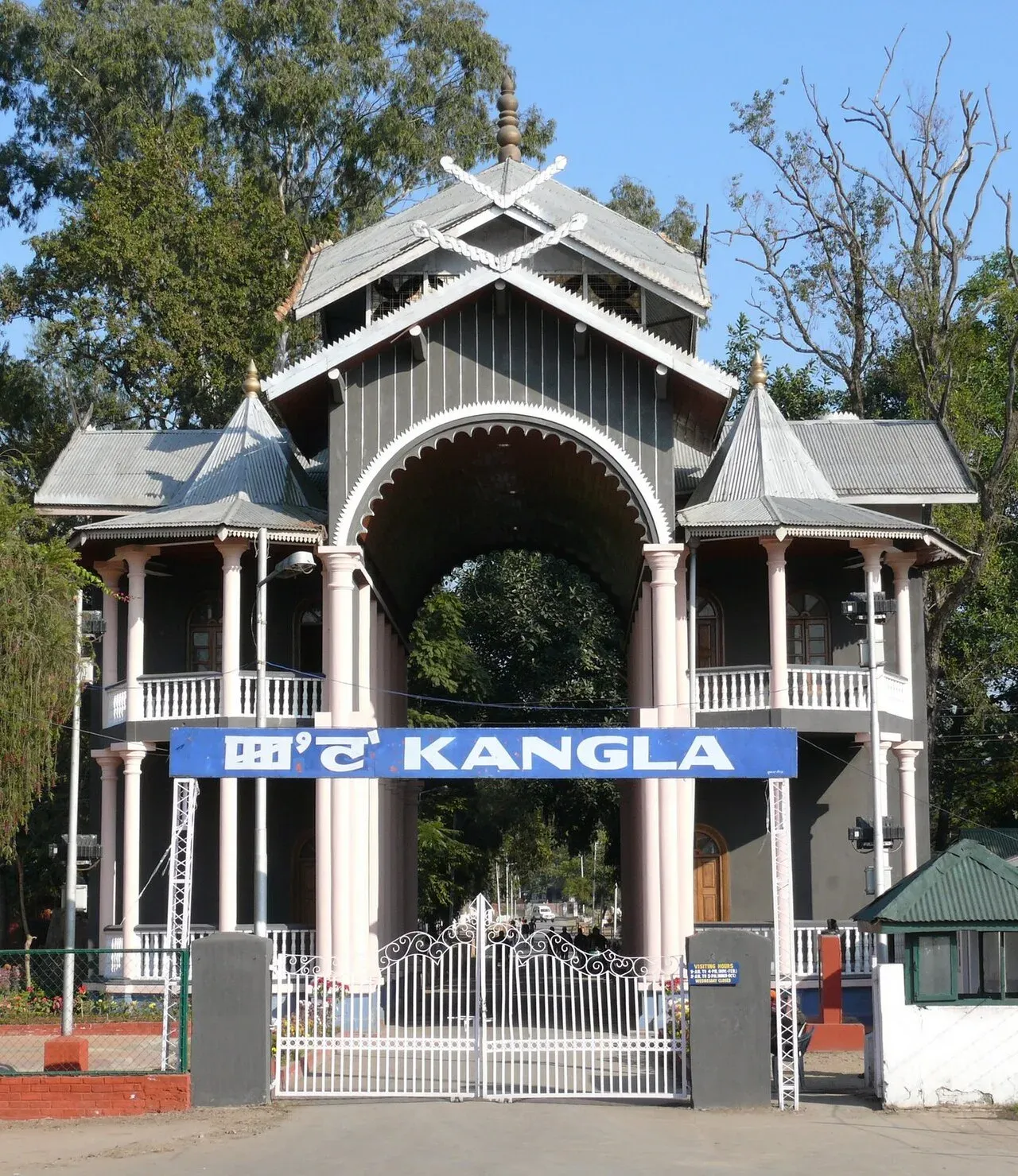
At its heart stands Kangla, the former royal and political centre and one of the most important historical places in the state. Sacred shrines, water bodies, archaeological remains and reconstructed structures within the complex continue to connect Kangla with Meitei history and identity.
The religious landscape of the valley also reflects different layers of belief.
Indigenous Meitei traditions centred on deities known as Umang Lai remain visible through festivals such as Lai Haraoba. Vaishnavism later became another major influence, contributing to devotional traditions such as Sankirtana and Ras Lila. Shree Shree Govindajee Temple beside the former royal palace remains one of Imphal's important Vaishnavite centres.
Manipur's modern history carries several equally significant chapters.
The Anglo-Manipur War of 1891 ended the kingdom's political independence under British intervention, and sites such as Khongjom and Shaheed Minar commemorate those who fought in the conflict. During the Second World War, the region again became strategically important. At Moirang, the flag of the Indian National Army was raised on 14 April 1944, an event remembered today through the INA Memorial and museum.
Manipur attained full statehood within India on 21 January 1972.
Festivals
Manipur's festival calendar reflects the diversity of its communities.
Some festivals belong particularly to the Meitei cultural world of the valley. Others are celebrated by Naga communities or Kuki-Chin-Mizo groups in the surrounding hills. Agricultural cycles, indigenous belief, Vaishnavite traditions, family relationships and seasonal change all play a role.
| Festival | Usual timing | Community / region | What it represents |
|---|---|---|---|
| Gaan-Ngai | December / January | Rongmei and related Zeliangrong communities | Community celebration, remembrance, feasting and cultural tradition |
| Lui-Ngai-Ni | 15 February | Naga communities | Seed-sowing season and the beginning of cultivation |
| Yaoshang | February / March | Primarily Meitei / Valley | Five-day spring festival associated with Thabal Chongba and community celebration |
| Cheiraoba | April | Meitei | Traditional New Year and renewal |
| Shirui Lily Festival | Usually May | Ukhrul | Celebration of Manipur's rare state flower and Tangkhul cultural landscape |
| Lai Haraoba | Usually May–June, varying by locality | Meitei | Worship of traditional deities and ancestors |
| Kut | 1 November | Kuki-Chin-Mizo communities | Post-harvest thanksgiving |
| Ningol Chakouba | November | Meitei | Family reunion centred on married daughters and sisters |
| Manipur Sangai Festival | Usually late November | Statewide showcase | Culture, crafts, cuisine, indigenous sport and tourism |
Dates vary, particularly for festivals connected with traditional calendars. Some festivals have also been disrupted or suspended in recent years.
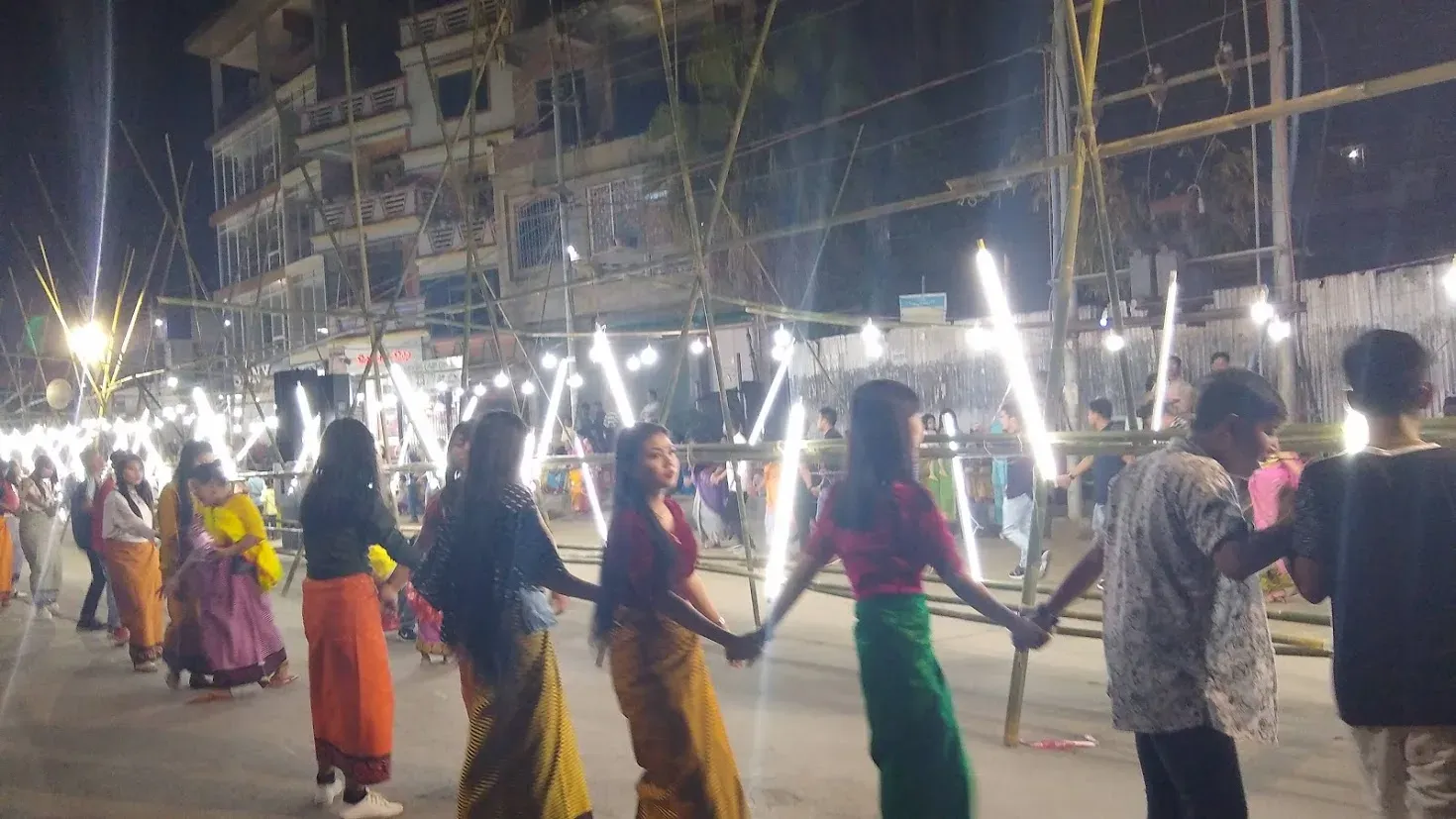
Yaoshang begins on the full moon of Phalguna, usually in February or March, and continues for five days.
One of its best-known traditions is Thabal Chongba, an evening folk dance in which participants form a circle and dance together. The festival combines religious observance, community gathering, sport and celebration and is one of the most widely observed festivals in the state.
Cheiraoba marks the traditional Meitei New Year and is usually celebrated in April.
Homes are cleaned, special dishes are prepared and offerings are made to deities and ancestors. A familiar part of the observance involves climbing nearby hilltops, symbolically looking towards greater heights in the coming year.
Few festivals reveal the older ritual world of the Imphal Valley as clearly as Lai Haraoba.
Celebrated in honour of the Umang Lai, the festival brings together ritual, music, dance and oral tradition. Maibis, or priestesses, perform dances that symbolically recount creation, domestic life and traditional occupations.
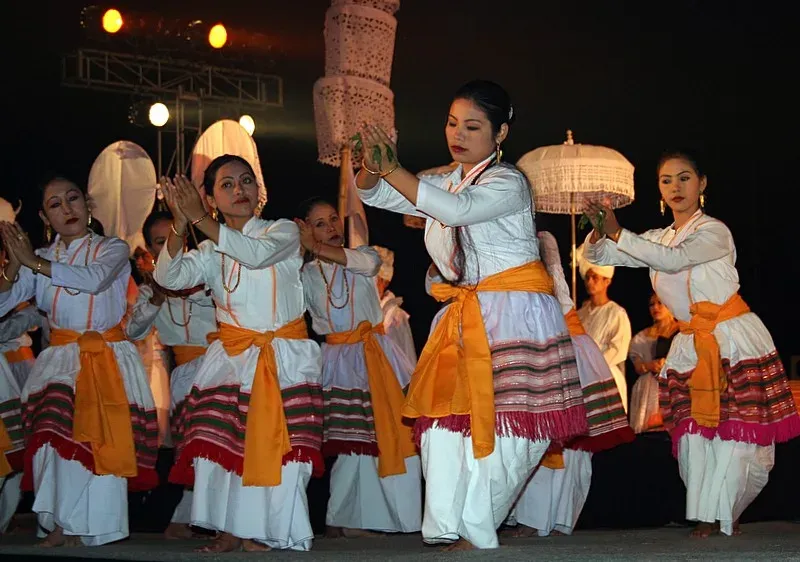
Different localities celebrate their own Lai Haraoba. The celebrations at Moirang, associated with the deity Thangjing, are particularly well known and usually take place around May.
In the hills around Ukhrul, May brings an entirely different cultural experience.
The Shirui Lily Festival celebrates Lilium mackliniae, Manipur's state flower, which grows naturally in the Shirui Hills. The festival combines the flowering season with music, cultural programmes, local food and awareness about protecting the rare plant and its habitat.
Observed on 1 November, Kut is a harvest festival celebrated among Kuki-Chin-Mizo communities of Manipur.
It marks the completion of agricultural work and a period of abundance, bringing communities together through food, dance, music and celebration.
Also celebrated in November, Ningol Chakouba centres on family.
Married daughters and sisters return with their children to their parental homes, where families gather around an elaborate meal. The festival remains one of Manipur's most distinctive social celebrations and places relationships between siblings and generations at its centre.
Dance
Few places in Northeast India are as closely associated with dance as Manipur.
Ras Lila is the best-known expression of Manipuri classical dance.
Rooted in Vaishnavite devotion, it interprets the relationship between Radha, Krishna and the gopis through highly controlled movement, music, costume and gesture. Traditional performances are closely associated with temples and religious occasions rather than simply the stage.
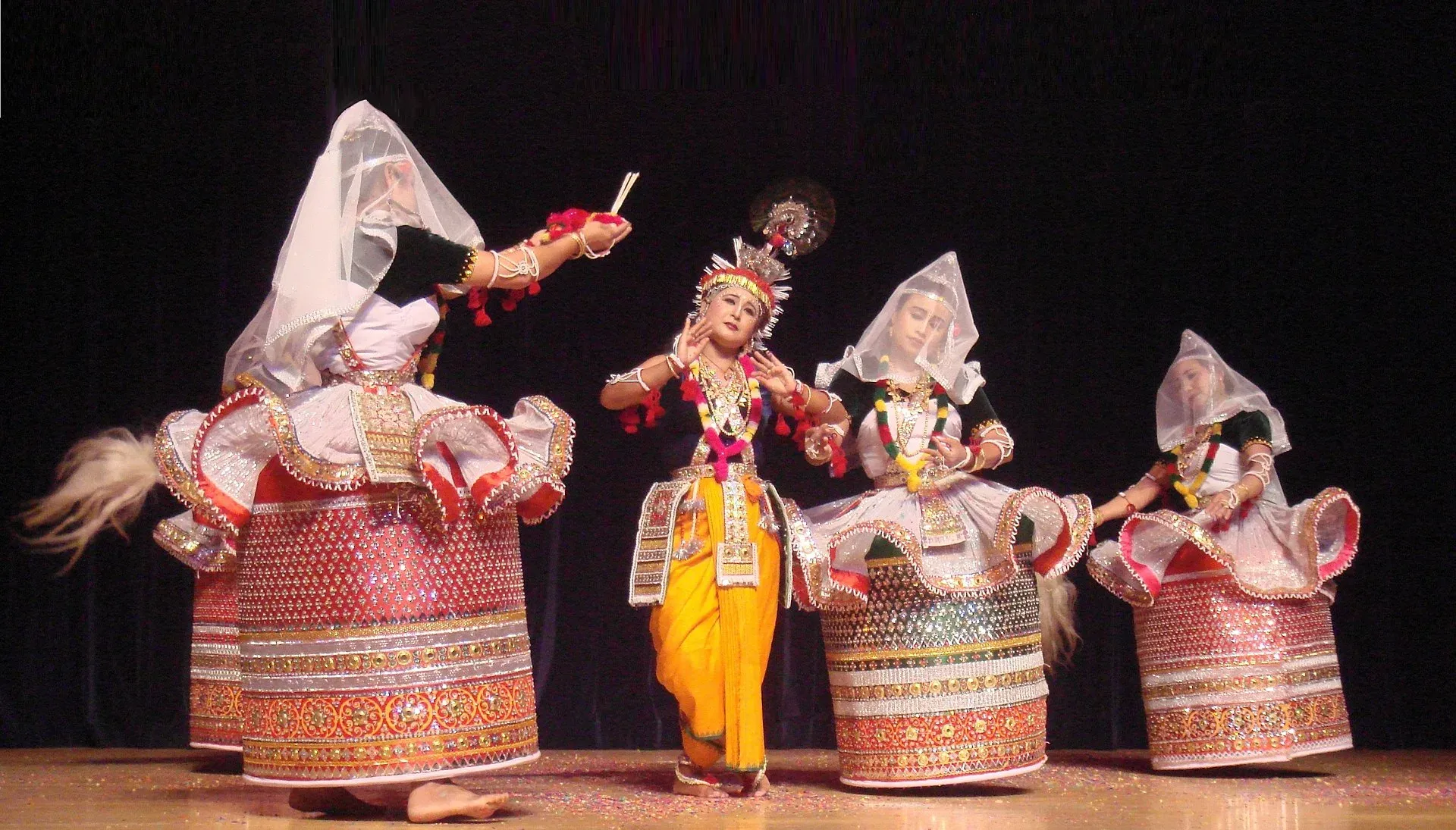
The visual language is immediately distinctive: restrained movement, flowing garments and circular formations create a performance that feels very different from the sharper rhythmic vocabulary of many other Indian classical forms.
If Ras Lila is defined by restraint, Pung Cholom brings energy.
Performers play the pung, the Manipuri drum, while executing increasingly vigorous movements. The instrument is central to Manipuri Sankirtana traditions, and Pung Cholom often appears before devotional and Ras performances.
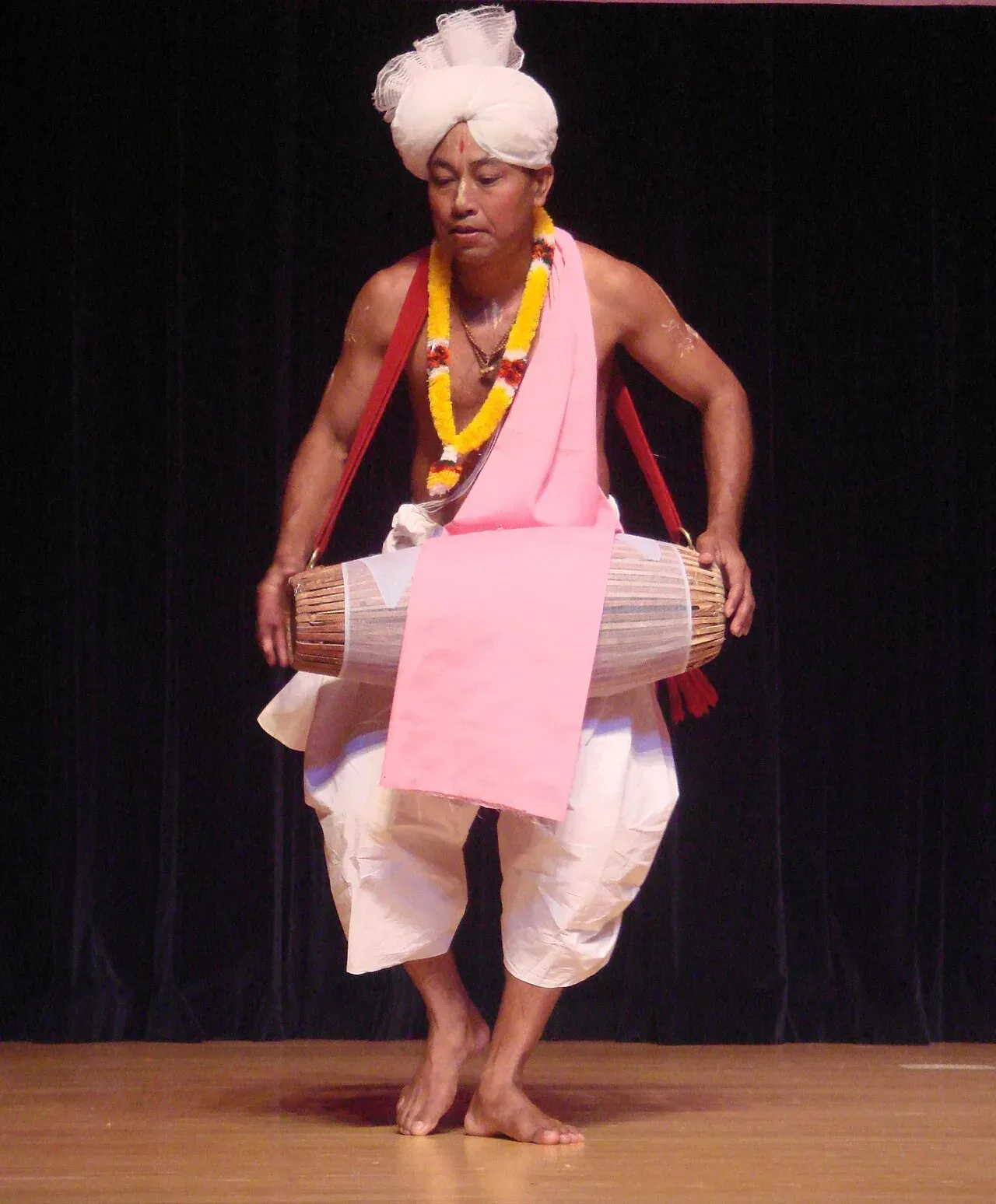
The Maibi dance forms part of Lai Haraoba and carries ideas of creation, community and traditional life through movement.
Khamba Thoibi, associated particularly with Moirang, takes its name from the legendary figures Khamba and Thoibi and is performed in devotion to Thangjing.
Together, these traditions show why the phrase "Manipuri dance" describes much more than one classical form.
Sport
Manipur's heritage is also carried through sport.
Sagol Kangjei, the traditional mounted game of Manipur, is widely recognised as an important predecessor of modern polo. British officers encountered the game in the nineteenth century, after which a modified form spread internationally.
At the centre of Imphal, Mapal Kangjeibung remains closely associated with this history and is regarded as the world's oldest living polo ground.
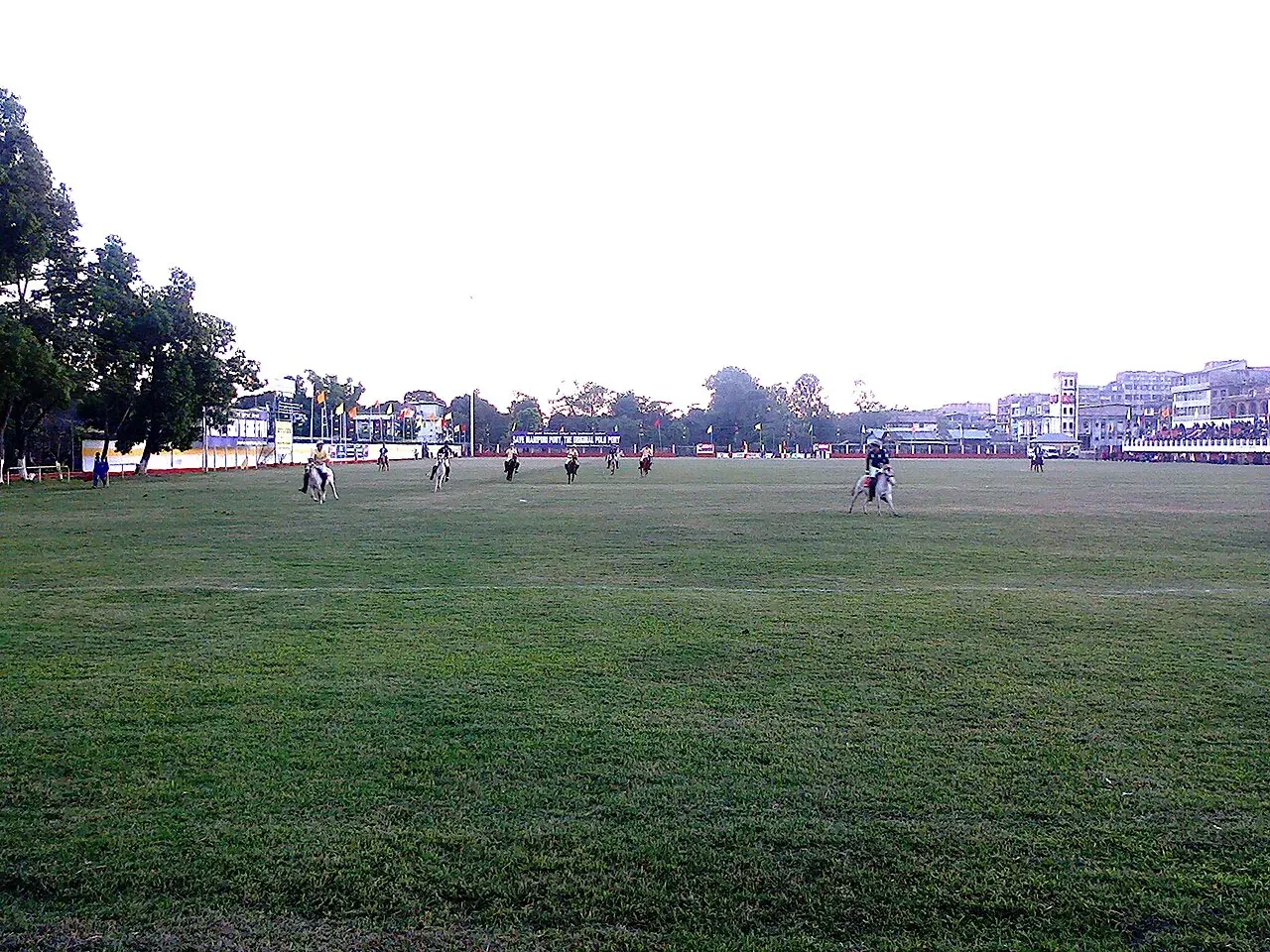
The traditional Manipuri pony is central to the game, making polo here as much a cultural tradition as a sport.
Other indigenous games include Yubi Lakpi, played with a coconut, Mukna wrestling, Kang, and traditional boat races.
Handloom
Weaving occupies an exceptional place in Manipur.
Handloom is the state's largest cottage industry, and women play a particularly strong role in traditional weaving. Village and community traditions produce everything from fine valley textiles to distinctive shawls from the hills.
Moirang Phee is one of Manipur's best-known textile traditions and takes its name from historic Moirang.
The fabric is distinguished by its characteristic border motif and may be woven in cotton or silk. Today it is produced beyond Moirang itself while retaining its connection to the region's weaving heritage. It is also recognised as a Geographical Indication product.
The Imphal region is also known for exceptionally fine weaving traditions such as Wangkhei Phee, while garments including the phanek and various shawls and wraps remain part of everyday and ceremonial clothing.
The surrounding hill districts contribute their own weaving traditions, colours and motifs.
A Tangkhul shawl from Ukhrul is not interchangeable with a textile from another Naga community or with Meitei weaving from the valley. Hill textiles vary considerably according to community and region.
Crafts
Textiles are only one part of Manipur's craft heritage.
Kauna, a water reed, is woven into mats, baskets, stools and household objects. Bamboo and cane are used for baskets, musical instruments, furniture, tools and decorative objects throughout the state.
One of the most distinctive traditions comes from Longpi, near Ukhrul.
Longpi or Nungbi pottery is made without a conventional potter's wheel.
Clay and black rock are combined and shaped by hand before firing. The finished pieces acquire a dark, almost metallic appearance and range from cooking vessels and cups to contemporary tableware.
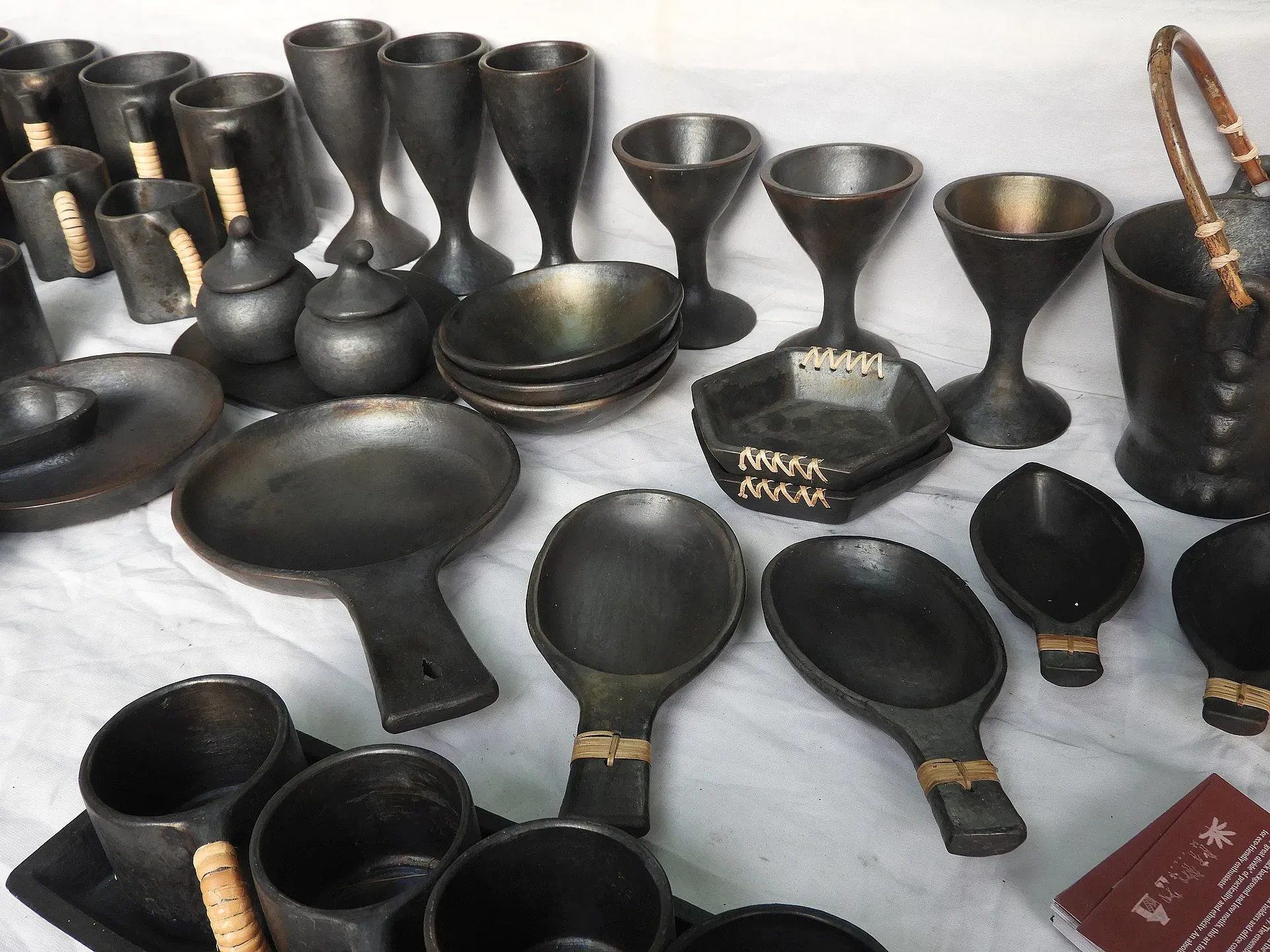
Because Longpi lies within the Tangkhul cultural landscape of Ukhrul, the pottery is also a reminder that Manipur's craft traditions extend far beyond the Imphal Valley.
Cuisine
Manipuri food is fresh, aromatic and strongly seasonal.
Rice forms the centre of many meals, accompanied by vegetables, fish or meat, herbs, fermented ingredients and salads. Boiling, steaming and relatively light cooking methods are common, while local greens and aromatic plants give many dishes their character.
As with the state's culture more broadly, food changes between the valley and different hill communities.
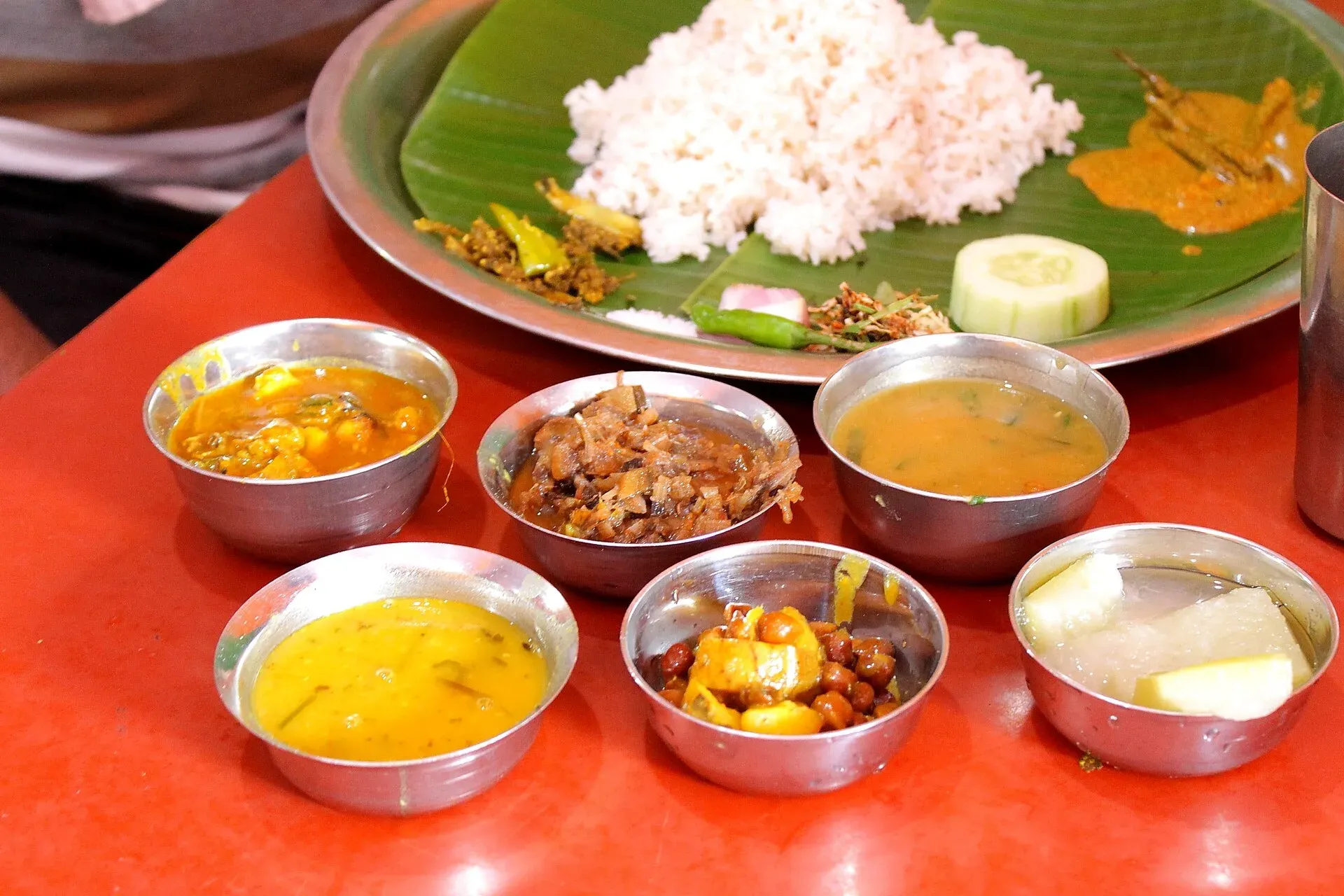
Eromba is one of the most recognisable dishes of the Meitei kitchen.
Boiled vegetables are mashed together with chilli and fermented fish, creating a preparation that is simple in appearance but powerful in flavour.
Singju is a traditional salad made using combinations of shredded vegetables, herbs and other ingredients.
Recipes vary widely, and the dish can range from fresh and herbaceous to spicy and deeply savoury depending on the preparation.
Chamthong, also known as kangshoi, is a light vegetable stew prepared with seasonal vegetables and aromatic herbs.
It reflects a characteristic feature of Manipuri cooking: allowing fresh ingredients to remain central rather than covering them in heavy sauces.
Fish is important in the food culture of the valley, and nga thongba refers broadly to fish curry preparations.
Freshwater fish from the lakes, ponds and wetlands of Manipur plays a particularly important role in everyday food.
Paknam is a savoury preparation made from gram flour with herbs, vegetables and seasonings, wrapped and cooked until firm.
It is a useful dish for anyone wanting to explore beyond the better-known curries and rice preparations.
Ooti is a mild preparation traditionally made from peas or other pulses.
Unlike several of Manipur's intensely flavoured fermented or chilli-based foods, ooti is gentle and comforting.
Manipur's chak-hao, or black rice, is used to make a distinctive purple-black rice pudding.
Cooked slowly with milk, the grain gives the dessert its characteristic colour, fragrance and texture. It is among the state's signature foods.
The food of Imphal, Ukhrul, Tamenglong and other regions reflects different ingredients and cultural traditions, so there is no single "Manipuri thali" that represents the state.
Places
Kangla, the former royal centre, provides the historical context needed to understand much of the city around it. Nearby are Shree Shree Govindajee Temple, the Manipur State Museum and the historic polo ground at Mapal Kangjeibung.
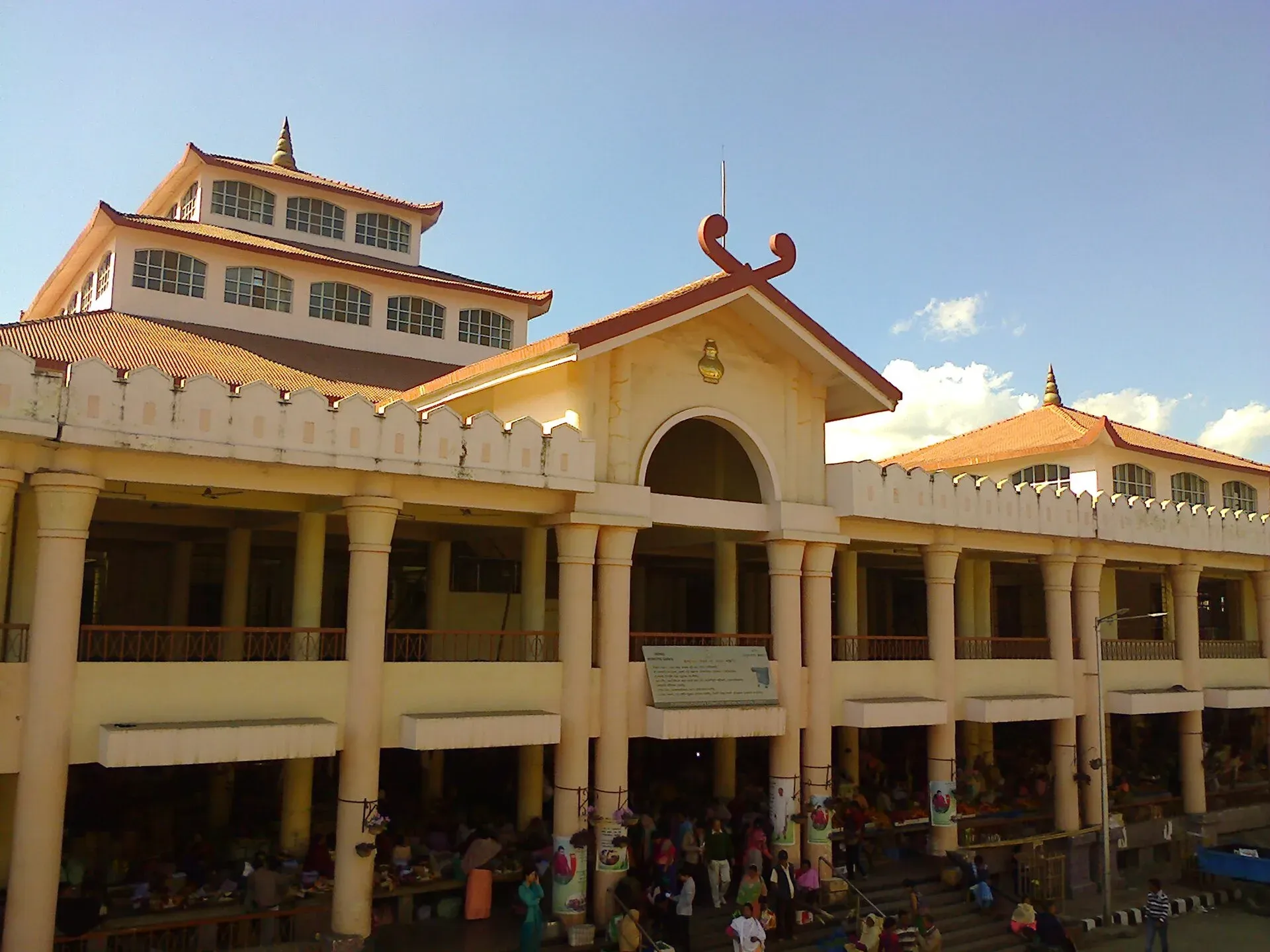
Ima Keithel is one of Imphal's most remarkable institutions. Thousands of women traders operate across the market complex, selling vegetables, fish, household goods, handloom and handicrafts. It is not simply a market — it is part of the economic and social history of the city.
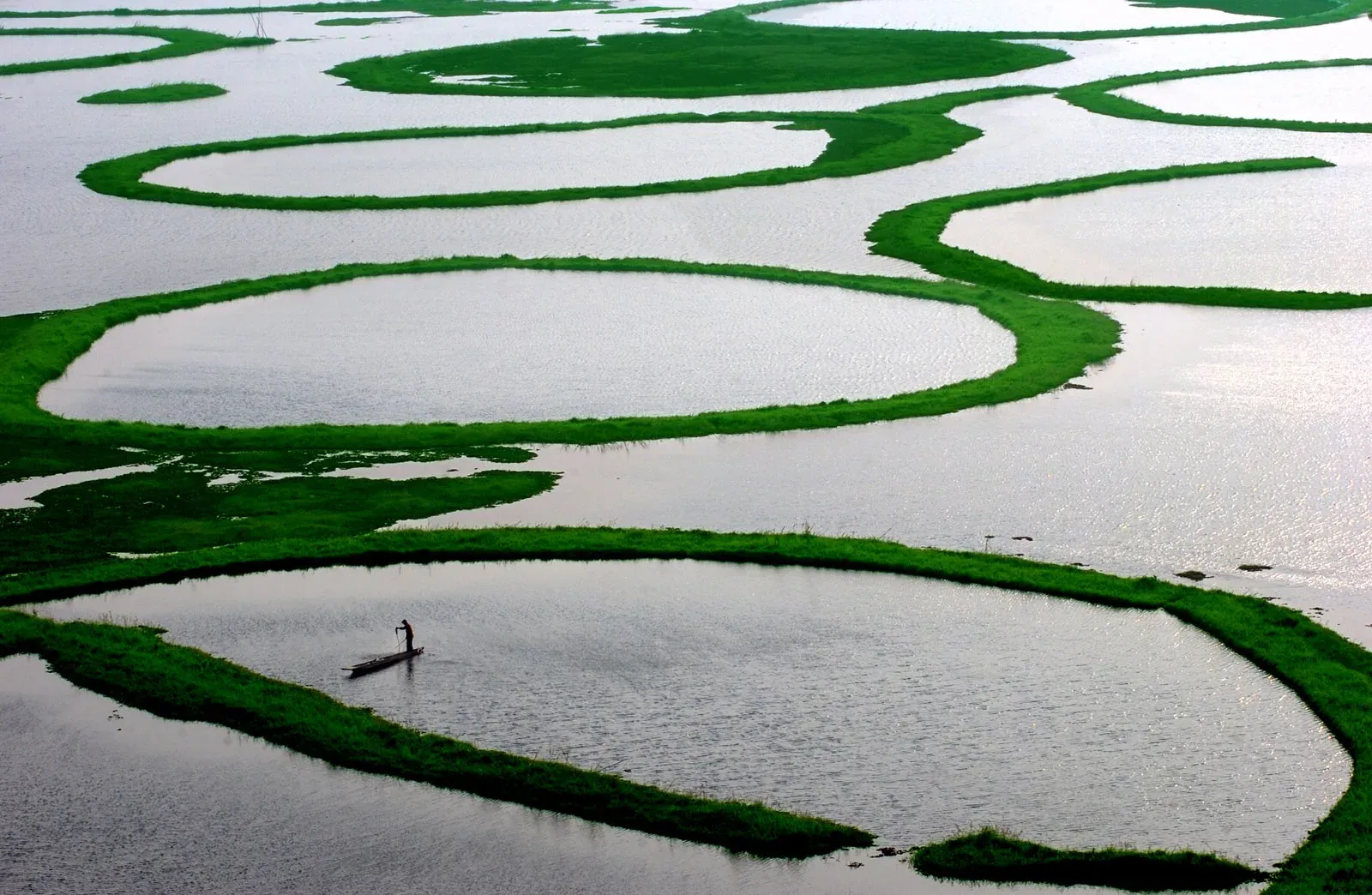
Around 48 kilometres from Imphal lies Loktak Lake, the largest freshwater lake in Northeast India.
Its defining feature is the phumdi, floating masses of vegetation, soil and organic material that form islands and wetlands across the lake. Fishing, settlements and livelihoods have developed around this unusual ecosystem.
On the southern side of Loktak lies Keibul Lamjao National Park, known for its floating wetland landscape and as the natural habitat of the Sangai, Manipur's brow-antlered deer.
The relationship between the Sangai, the phumdi and Loktak has become one of the strongest ecological symbols of the state.
Moirang brings several strands of Manipur's story together.
It is closely associated with the deity Thangjing, the legend of Khamba and Thoibi and an important form of Lai Haraoba. It is also home to the INA Memorial, marking the raising of the Indian National Army flag there on 14 April 1944.
Around 26 kilometres from Imphal, Andro holds the Mutua Museum, containing traditional objects, manuscripts, jewellery, wood carving and replicas of houses associated with different communities of Manipur.
It is a good place to understand material culture rather than monuments.
East of Imphal lies the cultural landscape of the Tangkhul Nagas.
The region is known for mountain scenery, village traditions, local food and the Shirui Hills, where the rare Shirui Lily blooms around May and June. Longpi pottery comes from this area.
Western Manipur is associated particularly with Rongmei, Liangmei and Zemei Naga communities, and is surrounded by forest, river valleys, caves and waterfalls.
Khongjom War Memorial commemorates the 1891 Anglo-Manipur War and those who died resisting the British advance. Khongjom Day is observed each year on 23 April.
Seasons
Manipur's climate shapes its festivals and agricultural year.
October to April is generally the driest and most comfortable period. May to October is the principal rainy season, though several important cultural and natural events fall within these wetter months — the Shirui Lily blooms in May and June, and Lai Haraoba celebrations take place around the same time.
February and March bring Yaoshang, the most energetic festival period of the year. November carries Kut, Ningol Chakouba and, in normal years, the Sangai Festival.
Getting there
Manipur has its own airport, so Guwahati is not its gateway.
Imphal Airport is the principal air entry point and is close to the city. Manipur is also connected by road with Nagaland and Assam, though routes cross mountainous terrain and journeys take longer than distances suggest. Rail connectivity within the state is still developing; the Jiribam–Khongsang section has been commissioned, while the larger project towards the Imphal Valley remains under construction.
Indian visitors from outside Manipur require an Inner Line Permit. Foreign visitors face separate requirements, including a Protected Area Permit, and should check current rules well in advance.
Given the current situation, anyone travelling should check the latest advisories and local guidance before making arrangements.
The region's waters
Manipur's floating islands and the Brahmaputra's vast braided channels belong to the same region but could hardly be more different — one a shallow lake of drifting vegetation, the other a river miles wide in places, carrying silt from Tibet to the Bay of Bengal.
That contrast is part of what makes Northeast India worth understanding as a whole rather than state by state. The water, the hills and the communities shift dramatically across relatively short distances.
If your journey through the region brings you to Guwahati, the Brahmaputra is best seen from the water. Our daily cruises sail through the year.
Good to know
Manipur is known for Loktak Lake, the Sangai deer, Manipuri classical dance, Pung Cholom, traditional handloom, indigenous sports including the origins of polo, Ima Keithel, Kangla and the cultural diversity of its valley and hill communities.
Important festivals include Gaan-Ngai, Lui-Ngai-Ni, Yaoshang, Cheiraoba, Lai Haraoba, Kut, Ningol Chakouba and the Manipur Sangai Festival. The Shirui Lily Festival is an important cultural and nature event in Ukhrul. Some have been disrupted in recent years.
Eromba, singju, chamthong or kangshoi, nga thongba, paknam, ooti and chak-hao kheer are all distinctive. Local cuisines vary between the Imphal Valley and different hill communities.
The traditional Manipuri game Sagol Kangjei is widely recognised as an important origin of modern polo. British officers encountered the game in the nineteenth century, and a modified form subsequently developed into the international sport.
As of August 2026, several governments advise against non-essential travel to Manipur following ethnic conflict that began in May 2023. The UK advises against all but essential travel, and the US maintains a Do Not Travel advisory. Curfews and movement restrictions continue in parts of the state. Anyone considering a visit should check current advisories from their own government and take local advice.
Yes. Indian visitors from outside Manipur require an Inner Line Permit, applied for through the state's official system. Foreign visitors require a Protected Area Permit and face separate requirements.
No. Imphal has its own airport. Guwahati becomes relevant mainly when Manipur is combined with Assam, Meghalaya, Arunachal Pradesh or a longer Northeast itinerary.